Order Now, Ships Today
One-time

These products are for laboratory research only and not intended for medical use. They are not FDA-approved to diagnose, treat, cure, or prevent any disease. By purchasing, you certify they will be used solely for research and not for human or animal consumption.
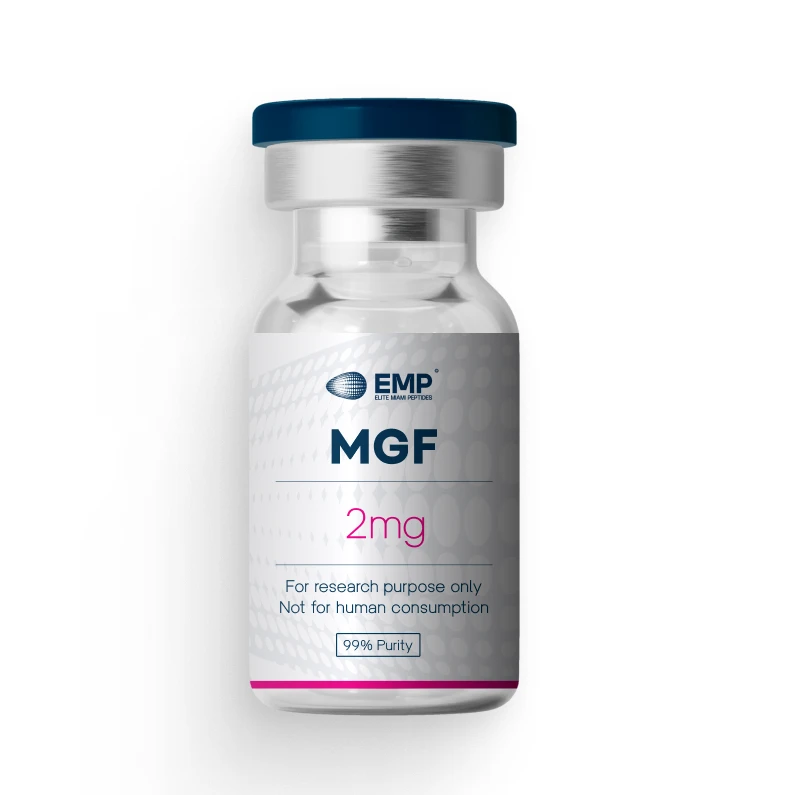
MGF (Mechano Growth Factor) is a synthetic peptide variant of IGF-1 designed for laboratory research. Each vial contains 2 mg of lyophilized peptide intended exclusively for controlled in-vitro and in-vivo experimental studies. MGF is not approved for human use and is supplied strictly for research purposes.
MGF is typically released at ≥98–99% purity, verified by HPLC and/or mass spectrometry. Lot-specific Certificates of Analysis usually include: Identity confirmation of MGF Purity profile and chromatograms Peptide content per vial (2 mg) Appearance (white to off-white lyophilized powder) Residual solvent and moisture levels within internal specifications The material is labeled strictly for research use only and not for human consumption.

Products from Elite Miami Peptides do not include usage instructions, as they are strictly for in vitro research and prohibited by law for human or animal use. Misuse or unlawful application will result in permanent denial of service.
Each vial contains exactly what’s indicated on the label. For instance, a 10mg vial contains precisely 10mg of lyophilized peptide. Researchers may divide it into smaller research portions—such as four 2.5mg aliquots—but the total content remains the same.
Yes. All peptides are supplied in lyophilized powder form and do not come reconstituted. Any extra materials required for research, such as solvents or diluents, must be obtained separately.
When stored as a dry powder, peptides remain stable for up to 2 years.
Once reconstituted, the solution should be kept refrigerated and is typically stable for up to 2 months under proper storage conditions.
MGF is an alternative splicing isoform of IGF-1 expressed in response to mechanical stress in muscle tissue. In research models, MGF has been used to study muscle repair, hypertrophy, satellite cell activation, and tissue remodeling. It provides a model to explore molecular pathways associated with mechanical-load–induced growth and regeneration in musculoskeletal systems.
In simple terms, MGF is a lab-only peptide that helps scientists study how muscle cells respond to stress or injury. It is used to see how mechanical signals trigger growth, repair, and activation of precursor cells in experimental models. This peptide is not a medicine or supplement and is for controlled research only.
⚠️ Disclaimer: this product is not approved for medical use and is not intended to diagnose, treat, or prevent any disease. All information provided is for educational and research purposes only, and this product must never be used in humans or animals.
MGF was first identified as a splice variant of IGF-1 produced locally in muscle after mechanical loading. Preclinical studies demonstrated its role in satellite cell proliferation and early muscle repair, leading to its adoption as a tool peptide in muscle biology, regenerative research, and aging studies.
MGF is a short peptide fragment derived from the IGF-1 gene with the unique C-terminal sequence that distinguishes it from systemic IGF-1. Sequence: species-specific variant depending on recombinant source Molecular weight: approximately 3–5 kDa depending on the fragment used Form: lyophilized powder, soluble in aqueous buffers for research use
Preclinical studies of MGF report: Activation of satellite cells in skeletal muscle models Enhanced cell proliferation and differentiation in vitro Modulation of local tissue repair pathways following injury or mechanical stress Improvements in muscle regeneration metrics in rodent models These findings are model-dependent and experimental.
Scientists use MGF to test how muscle tissue can repair and grow after stress or injury. In lab and animal models, it appears to promote precursor-cell activation and tissue repair, but all data are exploratory and do not support safety or effectiveness in humans.
Yang S. et al., 2013. “Mechano growth factor: isoform-specific role in muscle regeneration.” Journal of Cellular Physiology. Hill M., 2014. “Local IGF-1 splice variants and satellite cell activation in skeletal muscle.” Experimental Cell Research. Barton-Davis E. et al., 2003. “MGF peptide signaling in muscle repair and hypertrophy models.” FASEB Journal.
Our specialists respond within minutes to any order or product inquiry.
These products are for laboratory research only and not intended for medical use. They are not FDA-approved to diagnose, treat, cure, or prevent any disease. By purchasing, you certify they will be used solely for research and not for human or animal consumption.
By clicking the button above, you agree to receive marketing text messages from Elite Miami Peptides at the number provided. Consent is not a condition of purchase. Msg & data rates may apply. Reply STOP to cancel, HELP for help. View our Privacy Policy.
All compounds from Elite Miami Peptides are intended strictly for laboratory research purposes.
They are not for human use, consumption, or therapeutic applications.
Products are supplied exclusively to qualified professionals working in compliance with all applicable laws and regulations.
