

 In the rapidly evolving field of peptide pharmacology and biochemical research, the pursuit of highly selective compounds remains paramount. Researchers seek molecules that deliver targeted physiological responses without eliciting unwanted secondary effects.
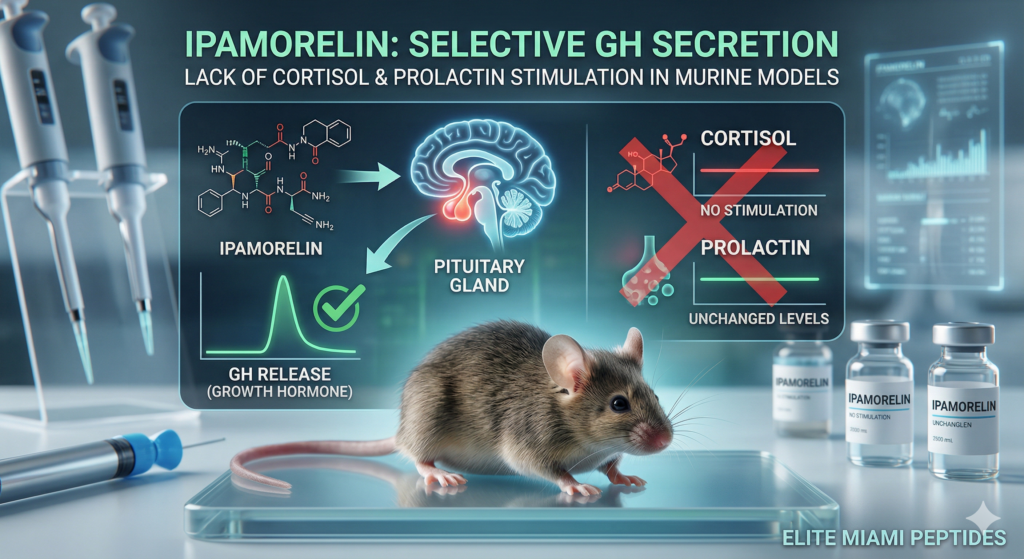
This article examines Ipamorelin, a third-generation growth hormone secretagogue (GHS), with a focus on its unique selectivity profile and its inability to stimulate cortisol and prolactin in murine models, distinguishing it from earlier compounds.
The Evolution of Growth Hormone Releasing Peptides (GHRPs)
To understand the significance of Ipamorelin, we must first look at the landscape of earlier GHRPs. Compounds like GHRP-6 and GHRP-2 paved the way for modern secretagogue research. They proved highly effective at binding to the ghrelin/growth hormone secretagogue receptor (GHSR-1a) in the anterior pituitary, reliably stimulating the endogenous pulse of Growth Hormone (GH).
However, these early-generation peptides came with a physiological “cost.” In various animal models, including murine (mice and rats) and porcine subjects, the administration of GHRP-2 and GHRP-6 resulted in a notable off-target effect: the simultaneous stimulation of adrenocorticotropic hormone (ACTH), which subsequently elevated cortisol, as well as prolactin.
In controlled research settings, elevated cortisol (a primary stress hormone) and prolactin can confound data, disrupt metabolic homeostasis, and introduce unwanted variables into long-term studies. Consequently, there was a need for a GHS that selectively stimulated GH release without affecting other hormonal pathways.
Ipamorelin: The Selective Pentapeptide
Ipamorelin is a synthetic pentapeptide (Aib-His-D-2-Nal-D-Phe-Lys-NH2) designed specifically to address the shortcomings of earlier GHRPs. Through careful structural modifications, researchers developed a molecule that retained strong binding affinity for the GHSR-1a receptor but exhibited a vastly refined selectivity profile.
The Murine Data: A Paradigm Shift in Selectivity
Pharmacological studies in murine subjects have provided robust data highlighting Ipamorelin’s unique biological effects. Intravenous administration of Ipamorelin to adult male rats produced the following results:
- Dose-Dependent GH Release: Ipamorelin elicited a powerful, dose-dependent release of Growth Hormone, demonstrating efficacy comparable to that of GHRP-6.
- Zero Cortisol Spike: Even when murine subjects were administered doses significantly higher than the ED50 (median effective dose) required for GH release, plasma levels of ACTH and corticosterone (the murine equivalent of cortisol) remained completely unchanged.
- Zero Prolactin Spike: Similarly, prolactin levels exhibited no statistically significant elevation, regardless of the dose administered.
Why This Lack of Stimulation Matters
The absence of cortisol and prolactin stimulation is a defining characteristic that distinguishes Ipamorelin as a valuable subject of study.
- Cleaner Research Models: For studies investigating the isolated effects of elevated Growth Hormone on muscle hypertrophy, bone density, or lipolysis, Ipamorelin enables data collection without interference from glucocorticoid (stress hormone) activity.
- Preservation of Homeostasis: Chronic elevation of cortisol in murine models can lead to muscle catabolism, immunosuppression, and insulin resistance—effects that directly counteract the anabolic and metabolic benefits of GH. By avoiding ACTH stimulation, Ipamorelin preserves the subject’s baseline endocrine balance.
- Appetite and Gastric Emptying: Interestingly, while Ipamorelin acts on the ghrelin receptor, it generally does not induce the intense, hyperphagic (extreme hunger) response observed in mice treated with GHRP-6, further demonstrating its highly specific, targeted action.
Ipamorelin exemplifies advanced peptide engineering by enabling potent Growth Hormone release without unwanted stimulation of cortisol and prolactin. This selectivity has established Ipamorelin as one of the most efficient and highly regarded peptides in contemporary murine research.
This targeted profile allows researchers to observe the direct effects of endogenous GH pulsing, making Ipamorelin a valuable tool for investigating metabolic function, cellular repair, and longevity.
Disclaimer: The information provided in this blog post is strictly for educational and informational purposes. Ipamorelin and all products sold by Elite Miami Peptides are strictly for laboratory research use only and are not intended for human consumption, diagnostic, or therapeutic purposes.