

1. Defining DSIP as an Analyte in Neurochemical Research
Delta Sleep-Inducing Peptide (DSIP) is a naturally occurring nonapeptide first isolated and characterized in 1974 during laboratory investigations of cerebral venous blood collected from rabbits undergoing experimentally monitored EEG slow-wave activity. In contemporary biochemical and pharmacological research, DSIP serves as a model analyte for investigating neuropeptide transport kinetics, peptide-protein interactions, and neuroendocrine signaling pathways.
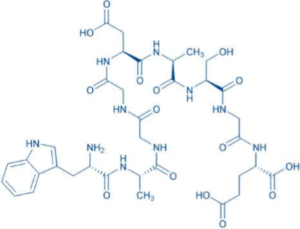
Structurally, DSIP is an amphipathic peptide composed of nine amino acid residues with the canonical sequence: Trp-Ala-Gly-Gly-Asp-Ala-Ser-Gly-Glu
With a molecular weight of approximately 849 Da, DSIP contains both aromatic/hydrophobic residues at the N-terminus (Trp^1) and acidic/polar residues toward the C-terminus (Asp^5 , Glu^9). This unique charge distribution and conformational flexibility make it an area of interest for laboratories studying how oligopeptides interact with endothelial lipid bilayers and enzymatic degradation systems.
2. Endogenous Localization & Immunoactivity Mapping
Mapping the anatomical distribution of peptides is a foundational aspect of preclinical laboratory characterization. Sensitive radioimmunoassay (RIA) techniques and high-performance liquid chromatography (HPLC) coupled with mass spectrometry have enabled quantification of immunoactive DSIP across distinct biological compartments in animal models.
- Central Nervous System (CNS) Localization: In rodent models, immunoactive DSIP is widely distributed throughout the brain, with prominent concentrations quantified in the hypothalamus, thalamus, and cerebral cortex.
- Pituitary & Neuroendocrine Axis: Substantial immunoactivity is observed within the pituitary gland, where investigators study its co-localization with other hypothalamic and pituitary signaling peptides.
- Peripheral Fluids and Diurnal Variation: Experimental assays in rats demonstrate that both brain tissue concentrations and circulating plasma levels of immunoactive DSIP exhibit statistically significant diurnal fluctuations over a standard 12-hour light/dark cycle. Notably, plasma immunoactivity correlates directly with CNS tissue concentrations under controlled laboratory conditions.
3. Blood-Brain Barrier (BBB) Permeability & Transport Kinetics
A central objective in experimental peptide science is to determine whether and how an oligopeptide traverses the microvascular endothelium of the blood-brain barrier (BBB). Hydrophilic and larger-molecular-weight analytes are typically excluded by tight junctions; therefore, specialized in-vitro and in-vivo models are employed to evaluate transendothelial flux.
In-Vitro Endothelial Monolayer Assays
In seminal in-vitro characterization studies using primary cultures of bovine brain microvessel endothelial cell (BMEC) monolayers mounted in a side-by-side diffusion apparatus, investigators tracked intact DSIP penetration using HPLC with UV detection at 280 nm.
Experimental Parameter | Observed Kinetic Finding in BMEC Models | Scientific Interpretation |
Concentration Dependence | Linear transendothelial flux with increasing concentrations | Non-saturable transport mechanism |
Temperature Sensitivity | Flux rate unaltered by reduced temperature | Passive diffusion rather than active/ATP-dependent transport |
Directionality | Equal rates of luminal-to-abluminal and abluminal-to-luminal flux | Bidirectional movement across microvessel monolayers |
Metabolic Inhibition | Insensitive to metabolic inhibitors | Independent of cellular energy metabolism |
Competitive Inhibition | Not altered by high concentrations of free tryptophan | Does not rely on neutral amino acid transporter systems |
In-Vivo Radiotracer Profiling
To corroborate cell-culture findings, preclinical in-vivo studies have utilized radioiodinated analogues, such as [^125]N-Tyr-DSIP, to measure blood-to-brain and blood-to-CSF clearance in rodent and canine models. These studies confirm that transendothelial crossing occurs via a non-competitive, simple transmembrane diffusion process that scales with plasma concentration. Furthermore, laboratory tracking reveals that BBB permeability to [125I]N-Tyr-DSIP can be modulated by experimental alterations in ambient lighting schedules and neuroendocrine parameters.
4. Enzymatic Degradation & Metabolic Stability at the Endothelium
When studying peptide flux across microvascular barriers, analytical chemists must account for enzymatic cleavage occurring at the endothelial surface. Brain microvessel endothelial cells express membrane-bound peptidases capable of hydrolyzing oligopeptide bonds.
[Amino-peptidases / Peptidyl Dipeptidase A at BMEC Surface] │ ▼ N-term ─ Trp – Ala – Gly – Gly – Asp – Ala – Ser – Gly – Glu ─ C-term ▲ ▲ │ │ [Des-Trp Metabolite] [C-terminal Hydrolysis]
- Enzymatic Catalysts: Experimental assays in cultured bovine brain microvessel endothelial cells (BBMEC) demonstrate that DSIP metabolism at the blood-brain barrier is catalyzed by surface-active amino-peptidases as well as peptidyl dipeptidase A.
- Metabolite Profiles: Analytical tracking identifies the primary metabolites of degradation as free tryptophan (Trp) and des-Trp^1-DSIP.
- Apparent Stability During Flux: Despite the presence of endothelial proteases, quantitative diffusion experiments across BMEC monolayers demonstrate an apparent degradation half-life (t1/2) of approximately 10 hours for the intact peptide. This relatively slow rate of in-vitro hydrolysis allows a quantifiable fraction of intact nonapeptide to complete transendothelial passage during standard assay timeframes.
5. Modern Research Innovations: Carrier Fusion Constructs
In contemporary molecular biology and synthetic peptide engineering, DSIP is frequently used as a model sequence to evaluate novel blood-brain barrier drug-delivery platforms. Due to the limited absolute bioavailability of bare nonapeptides across biological membranes, engineered fusion constructs have been developed to enhance transendothelial delivery in experimental models.
- Cell-Penetrating Peptide (CPP) Conjugation: Researchers have engineered recombinant fusion proteins combining DSIP with Cell-Penetrating Peptides / Crossing Blood-Brain Barrier Peptides (CBBBP), such as Tat-derived cationic sequences (GGGGYGRKKRRQRRR).
- Flexible Linker Integration: To preserve the independent folding and biochemical activity of the DSIP sequence, laboratories incorporate short, flexible glycine-serine linkers (e.g., GGGGS) between the carrier motif and the DSIP domain.
- Recombinant Yeast Expression: Recent biochemical studies have utilized secretory expression vectors in Pichia pastoris to biosynthesize and isolate intact DSIP-CBBBP fusion peptides. These constructs allow laboratory investigators to analyze how membrane-translocating domains influence peptide distribution, receptor binding kinetics, and neurotransmitter modulation in animal research models.
6. Summary for Laboratory Investigators
For researchers developing analytical protocols or studying peptide transport kinetics, DSIP provides a well-documented baseline analyte:
- Molecular Identity: A 9-amino-acid amphipathic peptide (~849 Da) with defined endogenous immunoactivity in hypothalamic, thalamic, and pituitary tissues.
- BBB Transport Kinetics: Crosses microvascular endothelial monolayers via non-saturable, bidirectional transmembrane diffusion independently of active carrier systems.
- Metabolic Considerations: Subject to cleavage by endothelial amino-peptidases and peptidyl dipeptidase A, yielding characteristic des-Trp metabolites, while retaining sufficient stability for measurable intact transendothelial flux.
Analytical-grade peptide reagents and research materials are available in the technical catalog at Elite Miami Peptides.